Oracle NetSuite
Cash Forecasting
Most small businesses don't fail because the business idea was wrong, they fail because they run out of cash. As part of NetSuite's Cash & Profits product team, I helped design a vision for how NetSuite customers could see their cash position clearly, understand what's coming, and act on it before a shortfall becomes a crisis.
What started as a concept for our SuiteWorld conference keynote became something bigger: the guiding design direction for how NetSuite approaches financial forecasting, and the project that helped establish our early patterns for agentic, AI-assisted workflows.

The Challenge
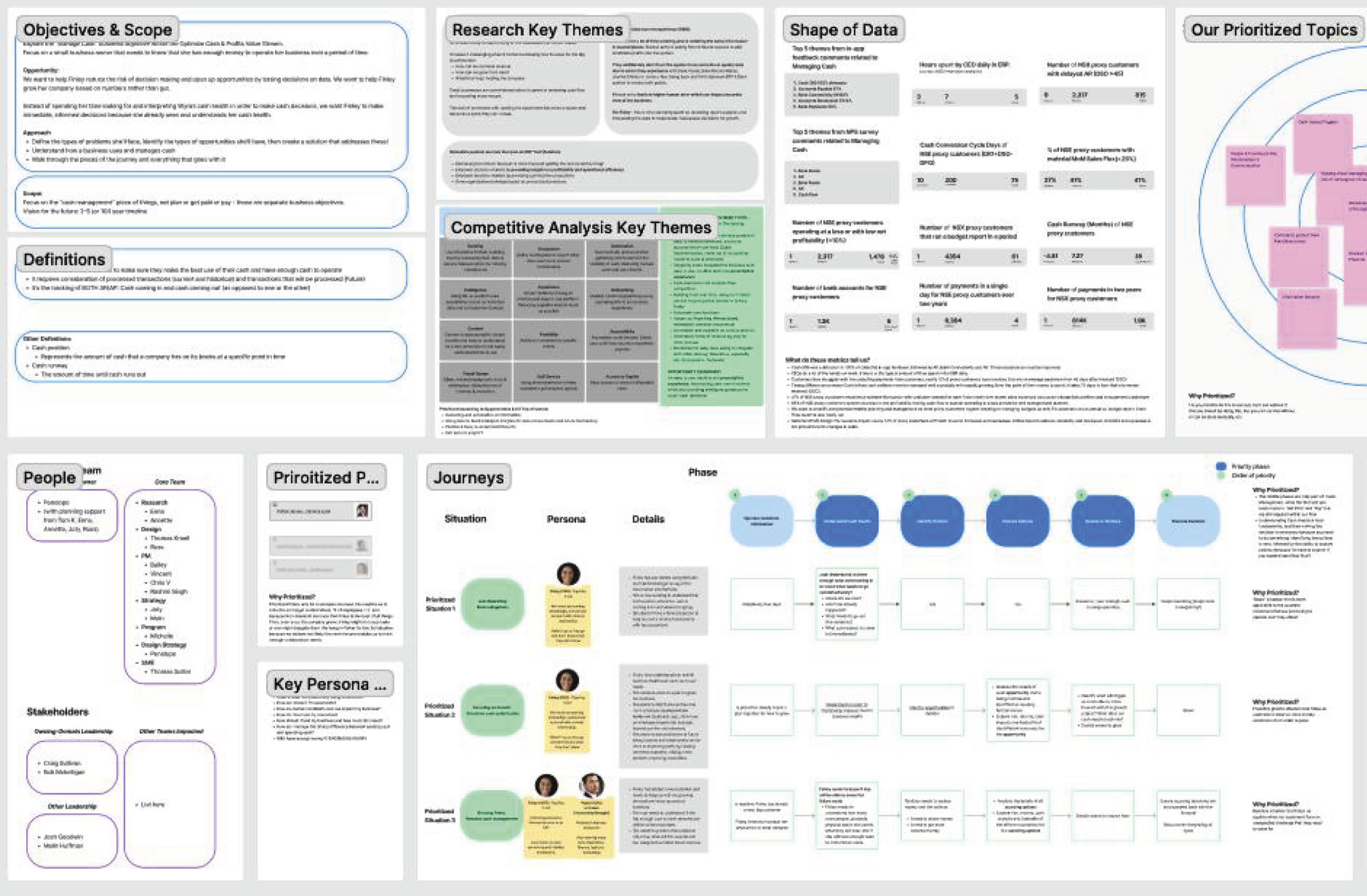
Managing the cash flow is one of the highest-stakes, lowest-visibility problems a small business will owner face. The research conducted at the beginning of this project gave us a very clear sense of our user’s problems.
The typical NetSuite customer's cash conversion cycle is 75 days
Typical cash runway sits at just 5 days
41% of customers see material (25%+) month-over-month swings in sales
One customer summed up the stakes simply: "Can we keep the lights on? We almost closed during the pandemic; almost ran out of cash."
Existing dashboards gave our users plenty of metrics, KPIs, and charts. What they actually needed was different: explanations and actionable next steps. Knowing your balance is low doesn't help if you don't know why, what's coming, or what you can do about it today.
The goal
A unified cash management process
Operate: businesses need accurate, real-time financial information
Understand cash health: all financial information in one place, both short-term and projected
Indentify and explore options: surface all available levers for cash risk, growth, and their tradeoffs
Execute decisions: turn decisions into reality
Monitor progress: evaluate what worked, adjust and feed that learning back into the cycle
The Solution
Cash Overview
The landing experience gives users an at-a-glance read on their cash position with metrics like current balance, projected inflows and outflows, and projected end balance. Importantly, there are two key trust signals: a confidence level on each projection, and a cash runway indicator. When a risk surfaces (like a projected dip below the customer's cash buffer), it's flagged immediately with a visual the user cannot ignore.
Cash Forecast
Clicking the flagged risk on the overview page takes the user to a dedicated Cash Forecast page. This view breaks down exactly what is driving the projected shortfall. It guides the user through which customer payments are delayed, which vendor payments are coming due, and the reasons behind them.
Connecting cause and timing
One of the trickier UX problems was helping the user understand why a sales campaign, a good thing, could create a cash crunch. We designed a timeline view that ties business events directly to the costs it triggers, so the cause of a projected dip is never a mystery.
Cash Health Simulator
This is where the workflow moves from problem area to the solution space. The system, powered by NetSuite AI, identifies specific options already available to the customer. This customer can extend terms with particular vendors or sell specific open invoices through NetSuite Capital. As a user selects options, the projected cash impact updates live against their cash goal. Selecting multiple options stacks their impact so users can build a plan rather than guess at a single fix.
From decision to execution
Once a user commits to a set of options, the workflow will show exactly what’s been set in motion. Payment dates are adjusted, invoices have been submitted for sale, and offer emails drafted and assigned to a teammate to review. The graph also shows the specific impact each action has made and the overall effect to the cash buffer. The user can be confident in these AI-assisted and implemented decisions because they have been shown many trust-building features along the way.
Results
This project did what a lot of vision-stage work doesn't: it stuck. It became the guiding design direction for NetSuite's financials products, and the patterns we defined for surfacing AI-driven recommendations and letting users act on them directly became a springboard for NetSuite's broader agentic design patterns. It remains the North Star vision for how NetSuite approaches cash management.
Contributions
Visual design leadership: Led visual design for the project, directing the overall visual direction and designing the data visualizations that made a large volume of financial information understandable at a glance. Other designers on the team consulted and gave input, but final visual decisions were mine.
UX & strategy: Contributed heavily to UX design and was part of the overall product strategy from early on, helping define the problem space, translate research into the Unified Cash Management Process framework, and sketch early user journeys.
Cross-functional collaboration: Worked most closely with a Lead UX Designer and Design Manager, and partnered with product managers, researchers, and stakeholders across the team to keep the vision aligned and grounded in reality.
Subject matter consulting: Consulted regularly with subject matter experts to make sure cash management concepts, like vendor terms, receivables, and forecasting logic, held up against real accounting and financial practices.
System fluency: Worked within NetSuite's existing design system, using components as-is where they fit, modifying them where they didn't, and designing net-new components where the system had no answer yet, all while keeping the work consistent with brand and product standards.